If you have ever worked with a vacuum furnace, you know one thing very clearly. Heat is everything. And power is what makes that heat possible.
Inside a vacuum furnace, especially one running at high temperature, you need to send a large and stable electrical current from the outside world into a sealed vacuum chamber. That sounds simple, but in reality, it is one of the hardest parts of the whole system.
This is exactly where a Vacuum Power Feedthrough with CF Flange comes in.
A vacuum furnace is not a gentle environment. Temperatures climb fast. Materials expand. Then they cool down, over and over again. At the same time, the vacuum level must stay clean and stable. No leaks. No outgassing. No surprises. If the power feedthrough fails, the whole furnace stops. That is not an option.
In high-temperature heating systems, the feedthrough does more than just “pass electricity”. It carries high current. It resists heat. And it holds vacuum, at the same time.
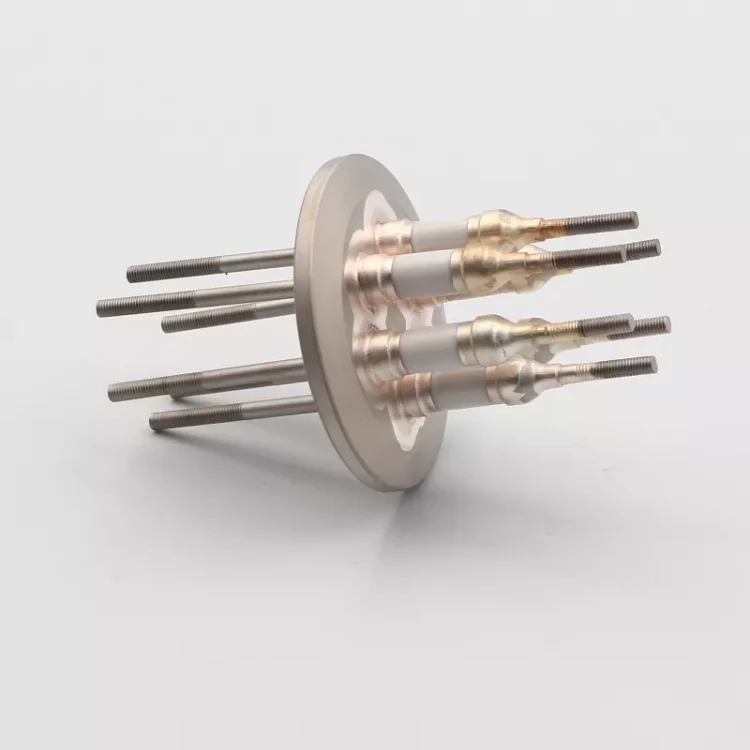
CF flanges are chosen here for a reason. They seal with a metal gasket, usually copper, which means the seal does not soften or creep when the temperature goes up. This is critical in vacuum furnaces used for sintering, brazing, diffusion bonding, or heat treatment of advanced materials. Rubber seals simply cannot survive these conditions. Metal seals can.
From the ceramic-metal interface point of view, this is where design really matters. The ceramic insulator inside the Vacuum Power Feedthrough with CF Flange must handle thermal stress, electrical stress, and mechanical stress all together. If the metallization is weak, cracks appear. If the matching is wrong, leaks happen. Slowly at first. Then all at once.
In real furnace operation, stability is the key word. Long heating cycles. High power loads. Sometimes continuous operation for days. A well-designed power feedthrough keeps doing its job quietly. No arcing. No overheating. No vacuum degradation. You do not notice it. And that is exactly how it should be.
That is why, in vacuum furnace systems, engineers tend to stay conservative. Once a Vacuum Power Feedthrough with CF Flange proves reliable, it stays in the design for years. Sometimes decades. Because replacing it means opening the chamber, breaking vacuum, realigning heaters, and losing production time.
In short, for vacuum furnaces and high-temperature heating systems, this type of feedthrough is not a “nice-to-have” component. It is a core part of the system. Quiet, strong, and absolutely unforgiving of mistakes.