In high-power laser and plasma equipment, nothing kills performance quicker than unmanaged heat. That’s where a Water-Cooled Power Feedthrough comes in. It’s simple in idea, but it changes how a system behaves under heavy load.
A Water-Cooled Power Feedthrough does two things at once: it brings power into a vacuum or sealed chamber, and it takes heat away. You run large currents through it; the ceramic-metal seals keep the vacuum tight; the water channels pull the heat out. That’s the recipe. No mystery.
Why this matters for lasers and plasmas
High-power lasers and plasma sources run hot — very hot. Electrodes glow, contacts warm, RF parts drift. Temperature shifts mean unstable beams, drifting focus, more noise. In plasma tools, heat alters sheath conditions and changes plasma chemistry. Neither is acceptable when you need repeatable results.
A Water-Cooled Power Feedthrough buys you stability. It prevents thermal runaway. It keeps contact resistance low. It protects the ceramic from thermal shock. The result: the system behaves the same run after run. For a production line or an experiment, that predictability is worth its weight.
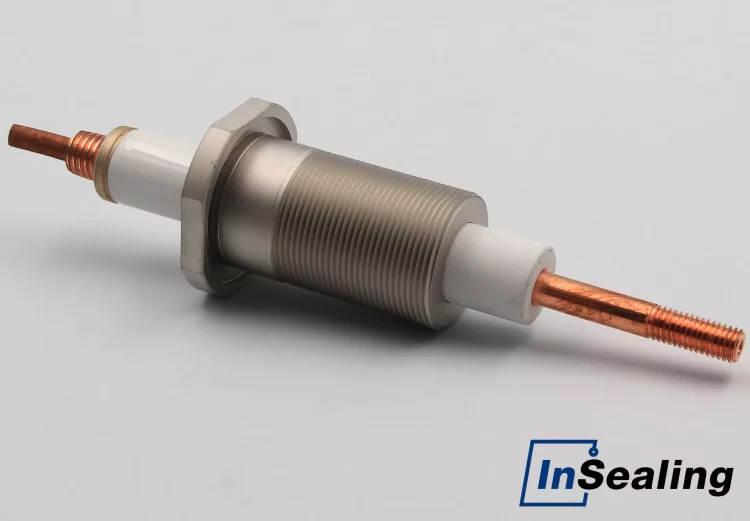
Vacuum Water Cooled Power Feedthrough
Practical benefits — plain and useful
First: higher continuous power. You can push more current, for longer, without the feedthrough failing. Short pulses might be fine without cooling — but continuous or high duty cycles need a solution that removes heat fast.
Second: longer life. Parts that stay cool last longer. That’s not poetic — it’s arithmetic. Metal expands less, ceramics stress less, seals don’t crack. Fewer replacements. Less downtime.
Third: cleaner vacuum. When components overheat they can outgas. That contaminates optics and substrates. Water cooling keeps surfaces below critical temperatures, so vacuum integrity holds and optics stay clean.
Design notes you should care about
Materials matter. Ceramic choice, metallization, and brazing technique — they all affect leak rate and thermal endurance. Design the cooling channels for good flow; stagnant pockets are trouble. Monitor the water temperature and flow. A slow leak in the cooling circuit is easier to catch than a slow ceramic crack — but both need attention.
Electrical path matters too. You want low contact resistance, solid mechanical connections, and good insulation. The feedthrough is not just a pipe for current; it’s part of the electrical circuit. Think about EMC/EMI if you’re dealing with RF or pulsed power.
Installation tips — things I always tell customers
Mount it so the water connections aren’t under torque. Use flexible hoses if needed. Keep sensors nearby — a simple flow switch and a temperature sensor save a lot of grief. Grounding must be solid. If you’re retrofitting, check the chamber geometry; clearance and accessibility make maintenance possible.
When to choose water cooling
If your duty cycle is high, or if continuous operation is required, choose a Water-Cooled Power Feedthrough. If you notice temperature drift, or you’ve had early failures tied to overheating, it’s time. For short low-duty pulses, air-cooled may be okay — but plan ahead. Upgrading to water cooling later is doable, but more costly.
Final word
In high-power laser and plasma work, the feedthrough is small in size but big in consequence. A well-designed Water-Cooled Power Feedthrough keeps currents steady, vacuums clean, and systems running. Spend time on the details — materials, cooling path, and mounting — and you’ll avoid the common headaches. That’s the craft. That’s the payoff.