Let’s talk RF. The real kind. Not the 2.4 GHz Wi‑Fi stuff. I mean microwave links, 5G backhaul, phased‑array radar – the bands where every millimeter of signal path matters.
Plastic packages don’t like those frequencies. Too much parasitic capacitance. Too much signal loss. And when you add heat? They just give up.
That’s why you see High-Density Leadless Ceramic Semiconductor Packages (CQFN / CLCC) inside those high‑end communication boxes. No leads. Short paths. Low loss. Simple, right?
Based on my experience, once you go above 10 GHz, a leadless ceramic package isn’t a luxury. It’s the difference between a product that works and one that never leaves the lab.
So what’s the difference between CQFN and CLCC?
CQFN has a big thermal pad underneath. That pad pulls heat away from power amplifiers. Great for transmit chains. CLCC is simpler – no thermal pad, just a solid ceramic box with castellations. It’s older, but it’s bulletproof. You see it in receivers, frequency sources, space stuff.
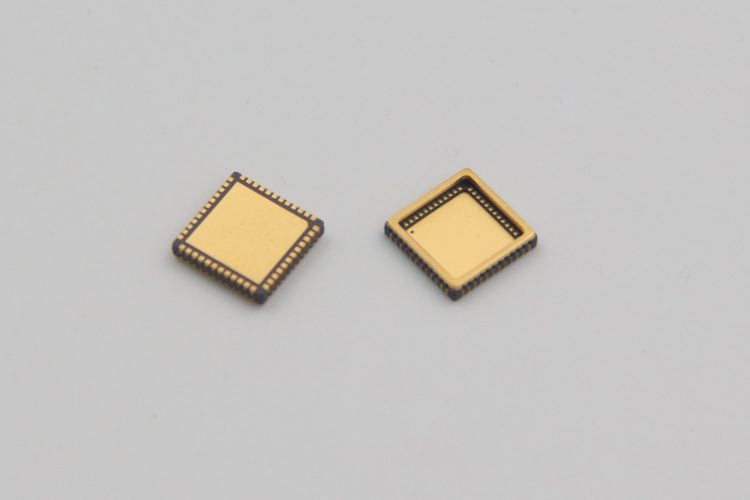
High-Density Leadless Ceramic Semiconductor Packages (CQFN CLCC)
Where do you actually find them?
In 5G massive MIMO radios – the little PA modules use CQFN. They need the heat path.
In microwave backhaul – those dish antennas on towers. CLCC keeps moisture out for 20 years.
In phased‑array radar – dozens of tiny modules. CQFN is low profile. Survives vibration.
In our tests, a CQFN package ran clean from DC to 38 GHz. After that, a small drop, but still usable up to 45 GHz. Good enough for defense bands.
Here’s a real spec comparison. The numbers come from typical datasheets.
| Parameter | CQFN (with thermal pad) | CLCC (standard) |
|---|---|---|
| Package size range (mm) | 3×3 up to 12×12 | 3×3 up to 20×20 |
| Pin count | 16 to 100+ | 16 to 68 |
| Maximum useful frequency | 40 – 50 GHz (HTCC) | 30 – 40 GHz |
| Thermal resistance (junction‑to‑case) | 5 – 12 °C/W (excellent) | 20 – 35 °C/W (moderate) |
| Hermeticity (leak rate, He) | ≤ 5×10⁻⁸ atm·cc/s | ≤ 1×10⁻⁸ atm·cc/s |
| Typical applications | Power amps, switches, LNA for 5G, radar | VCOs, mixers, frequency sources, space‑grade ICs |
Notice the CQFN thermal resistance? That’s 5 to 12 °C/W. Plastic would be three or four times higher. For a 5‑watt power amp, that’s the difference between 60°C case temp and 150°C. One works. One melts.
One more thing. Assembly. Because CQFN and CLCC have no leads, they don’t bend. You place them like any other QFN. No co‑planarity headaches. No bent pins at incoming inspection. That saves real money in production.
So yes, ceramic costs more. But when a tower radio fails at 2 am, the truck roll alone costs more than the package. Let alone the angry phone calls.
If your RF design goes above 3 GHz – especially above 10 GHz – do yourself a favor. Look at High-Density Leadless Ceramic Semiconductor Packages (CQFN / CLCC). Short signal paths. Low parasitics. Heat goes out the bottom. That’s how you build gear that lasts.