If you work in semiconductor manufacturing, you deal with vacuum. Every day. In processes like etching or deposition, the chamber needs to be cleaner than a hospital operating room. But here is the challenge. How do you get power and signals into that perfectly clean space to run things like heaters, sensors, or electrostatic chucks? You cannot just drill a hole and run a wire through it. That would break the vacuum instantly.
That is where a Multipin Vacuum Feedthrough comes in. Think of it as a sealed bridge. It carries electricity across the wall of the vacuum chamber without letting any air in. I found that in modern semiconductor tools, the demand for these components is growing fast. Why? Because wafers are getting more complex. We need more sensors inside the chamber to control the process precisely. That means more pins.
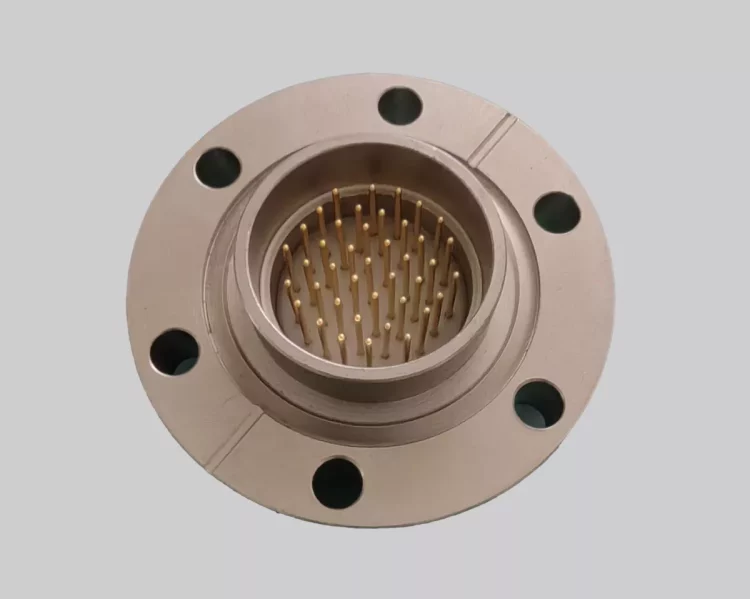
In our tests with etching equipment, we often use a 41-pin configuration similar to the CF35 model you mentioned. Forty-one pins might sound like a lot. But in a modern etcher, those pins disappear quickly. You need pins for the thermocouples to read temperature. You need pins for the heater to control it. You need pins to bias the wafer. And you need separate lines for redundancy, because if one sensor fails during a run, that batch of wafers is scrap. That costs real money.
The environment inside a semiconductor chamber is brutal. It is not just vacuum. It is plasma. It is reactive gases trying to eat everything. Based on my experience, the sealing between the metal flange and the ceramic insulator is the most critical part. If that seal leaks, even a tiny bit—at a rate worse than 1*10⁻⁹ Pa·m/s—the oxygen poisons the process. Your metal lines oxidize. Your device fails. So, that leak rate spec is not just a number on a datasheet. It is the line between high yields and total failure.
Also, consider the voltage. A 1500V withstand rating, like in that InSealing product, is essential for electrostatic chucks. Those chucks hold the wafer in place using static electricity. They need high voltage. If your feedthrough arcs over at that voltage inside the vacuum, it creates particles. Particles kill chips. So the insulation material and the design geometry have to be perfect.
So, when you look at a semiconductor fab running 24/7, these Multipin Vacuum Feedthroughs are the unsung heroes. They sit there, welded onto the chamber, maintaining the vacuum year after year, running wires for all the critical controls. Without them, you simply cannot build the advanced nodes we rely on today. They are a small part, but they enable the whole process. Reliability is everything.