Let‘s talk about analytical instruments. I’m talking about the heavy hitters here—mass spectrometers, electron microscopes, X-ray analyzers. These machines are basically vacuum detectives. They need a clean, empty space inside to chase down tiny particles or photons. But here is the catch: they also need electricity to run. High voltage, even. And electricity and a sensitive vacuum chamber? They don’t naturally get along.
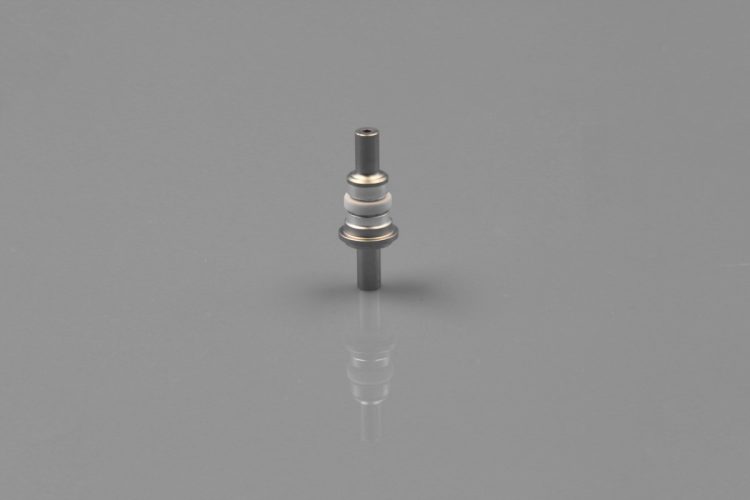
That‘s where a small but critical component comes in: Vacuum Electrical Isolators.
Think of it as a highly specialized pipe. It lets a cable or a conductive path go through the wall of the vacuum chamber. But it does something clever. It breaks the electrical path while keeping the vacuum seal perfect. So you can have 10,000 volts inside the chamber, but the metal wall outside stays at zero. No short circuit. No interference.
Why this matters for precision.
In our tests with high-end mass specs, we’ve seen how a tiny electrical leak can ruin a spectrum. It creates noise. It creates ghosts in the data. The isolator stops that. It ensures the signal you‘re analyzing is coming from your sample—not from some stray ground loop or electrical artifact.
The material story.
How does it work? It’s simple engineering, but it has to be perfect. You have a metal sleeve on one side (connected to the power source) and a metal sleeve on the other (connected to the instrument inside). In between? A ceramic tube. We use high-purity Alumina. It‘s an incredible insulator.
Based on my experience, the real magic isn’t just the ceramic. It‘s the bond. We brace that ceramic to the metal using high heat in a vacuum furnace. The joint has to be absolutely leak-tight. If it leaks air, the vacuum dies and the instrument is useless. If it conducts electricity, the instrument is useless.
Where you actually find them.
Open up a modern electron microscope. You’ll see one isolating the final lens assembly. In a gas analyzer, they isolate the filaments and the detectors. They are often welded onto beam lines or flanges, hidden in plain sight.
So, next time you see a clean spectrum or a sharp image from a scanning electron microscope (SEM), remember the quiet work of the Vacuum Electrical Isolator. It’s just a pipe. But it‘s a pipe that keeps the power in and the noise out.