If you run a vacuum furnace, you already know the weak link isn’t the heating element or the insulation. It’s often the point where electricity comes in from the outside. That little junction—the feedthrough—takes a beating. Heat radiates from the hot zone. Thermal cycling loosens materials. And one tiny leak can ruin an entire batch of parts.
That’s where High-Temperature Feedthrough Terminals become the real workhorse of your system. Not flashy. Just reliable.
Why Standard Connectors Don’t Cut It
Standard electrical connectors use plastic or rubber insulators. Those melt. Or they outgas and contaminate your vacuum. In a furnace running at 800°C to 1200°C, organic materials break down in minutes. You need something that holds up.
Ceramic does that. But ceramic alone is brittle. You can’t just run a wire through a ceramic tube and call it good. The joint between the ceramic insulator and the metal flange has to be absolutely tight. No micro-cracks. No gaps.
This is where ceramic-to-metal sealing technology comes in. The process brazes the ceramic to a metal housing using high-temperature alloys. The result is a single, solid piece that handles heat, pressure, and thermal shock.
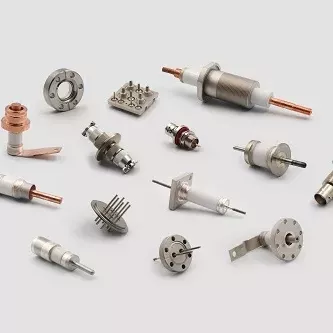
Based on my experience, the most common failure point isn’t the ceramic itself—it’s the pin material. Molybdenum and nickel-based superalloys work best. They have similar thermal expansion to the ceramic, so they don’t pull away when things get hot.
The Real Challenges Inside a Vacuum Furnace
Let’s break down what actually happens inside.
First, temperature. The feedthrough might sit on the cold wall of the furnace—say, 50°C on the outside. But the inner tip sees radiant heat from the hot zone. That tip can reach 400°C or more, even with active cooling. So one end is cold, the other is scorching. That gradient stresses every joint.
Second, thermal cycling. You heat up to 1000°C, hold for hours, then cool down. Repeat every day. Each cycle expands and contracts the metal and ceramic at slightly different rates. Over time, that movement can fatigue the braze joint.
Third, vacuum integrity. A good furnace runs at 10⁻⁵ Torr or lower. At that pressure, even a pinhole leak lets in enough air to oxidize your workload. The feedthrough has to hold that vacuum for years.
Materials That Actually Work
Here’s a quick look at what you’ll find inside a quality High-Temperature Feedthrough Terminal designed for furnace duty.
| Component | Typical Material | Max Service Temp (°C) | Key Property |
|---|---|---|---|
| Insulator | 95% or 99% Alumina (Al₂O₃) | 1600 | High dielectric strength, low outgassing |
| Center Pin | Molybdenum or Kovar | 1400 | Matches CTE to alumina |
| Housing | 304L or 316L Stainless Steel | 900 | Corrosion-resistant, weldable |
| Braze Alloy | Silver-copper eutectic or gold-nickel | 800 (service) | Wetting ability, ductility |
| Cooling Option | Water jacket (optional) | N/A | Reduces outer shell temp to <100°C |
That table isn’t theory. Those are the combinations that have been proven in thousands of furnace installations over decades.
Installation and Maintenance Tips
Getting the feedthrough in right is half the battle.
Mounting. Always use a copper gasket or O-ring that’s rated for your temperature range. Torque the mounting bolts in a star pattern. Uneven pressure can distort the flange and break the ceramic seal.
Cooling. If your furnace runs above 1000°C regularly, use a water-cooled feedthrough. Keep the water flow steady—not too fast, not too slow. Stagnant water lets heat creep up the pins. Too much flow can cause vibration.
Inspection. Check the exposed ceramic surface every few months. Look for discoloration or tiny cracks. If you see a brownish film, that’s metal vapor from your workload depositing on the insulator. That film can become conductive and cause arcing. Clean it gently with a soft abrasive pad—but never on the sealed area.
Replacement. When a feedthrough fails, replace the whole assembly. Don’t try to re-braze it in-house. The braze temperature is over 800°C, and you need a controlled atmosphere furnace to do it right. Send it back to the manufacturer.
Signs Your Feedthrough Is Failing
Catch these early and you save a full furnace rebuild.
Leak rate creeping up. Your pump runs longer to reach base pressure.
Intermittent power loss. The heating element cuts out randomly.
Visible arcing. You see a blue glow around the feedthrough during operation.
Cracked ceramic. Even a hairline crack means replacement.
Don’t ignore the small stuff. One failed feedthrough can take out your heating element, your insulation, and your workload all at once.
Why Not Just Use a Cheaper Option?
I’ve seen operators try to save a few hundred dollars by buying generic feedthroughs. It never works out. The pin metallurgy is wrong. The braze alloy doesn’t wet properly. The ceramic is 85% alumina instead of 95%, so it absorbs moisture and outgasses.
A proper High-Temperature Feedthrough Terminal costs more upfront, but it lasts 5 to 10 years in normal service. The cheap one might give you six months. Do the math on downtime alone.
Final Word
Your vacuum furnace is a major investment. Don’t let a $500 component turn into a $50,000 repair. Choose feedthroughs that match your temperature range, cooling method, and voltage requirements. Check the data sheet. Ask about the braze material. And if the supplier can’t tell you their leak rate in helium mass spectrometry, walk away.
Heat, vacuum, and time—those three things are always working against you. But with the right High-Temperature Feedthrough Terminals, you stay ahead of the curve.