You know what’s funny? Most people never think about the tiny seal that keeps a sensor alive. But if you work in instrumentation, or you design control systems for oil rigs, or you build medical monitors – that little glass-to-metal seal is often the difference between a reading you trust and a false alarm that costs thousands.
Sensors are everywhere today. Pressure transmitters down a wellbore. Temperature probes in a jet engine. Oxygen sensors in a car’s exhaust. And in all these places, the environment is nasty – heat, vibration, moisture, corrosive gases. The electronics inside are delicate. They need a barrier that doesn’t crack, doesn’t leak, and doesn’t degrade over decades.
That’s exactly what glass-to-metal sealing delivers.
Let me break it down simply. A glass-to-metal seal is basically a fused bond between a metal housing and a glass insulator, with one or more pins running through it. The glass melts and wets the metal, then cools into a compression fit. That compression is key – it keeps the interface tight even when temperatures swing from -200°C up to +300°C or more. No o-ring, no epoxy, no polymer can match that long-term stability.
Now, why does this matter specifically for sensors? Because sensors are only as good as their signal path. If moisture creeps in along a pin, you get leakage current. That shifts your zero point. Your 4-20 mA loop drifts. You start chasing ghosts in the data. In our tests, we’ve seen unsealed sensor headers fail within 200 thermal cycles – while glass-to-metal sealed ones ran past 5,000 cycles with no measurable change in insulation resistance. That’s not a small difference. That’s the difference between a field service call and a set-it-and-forget-it installation.
Take pressure sensors for hydraulic systems. These see rapid pressure spikes and constant vibration. The feedthrough has to hold its hermeticity – typically better than 1×10⁻⁹ atm·cc/s helium leak rate. Glass-to-metal sealing hits that easily. And it doesn’t creep under load. I’ve opened up twenty-year-old transducers from subsea applications – the seal looked as good as the day it was made. The metal had some surface rust, sure. But the glass? Intact. The pins? Still isolated from ground.
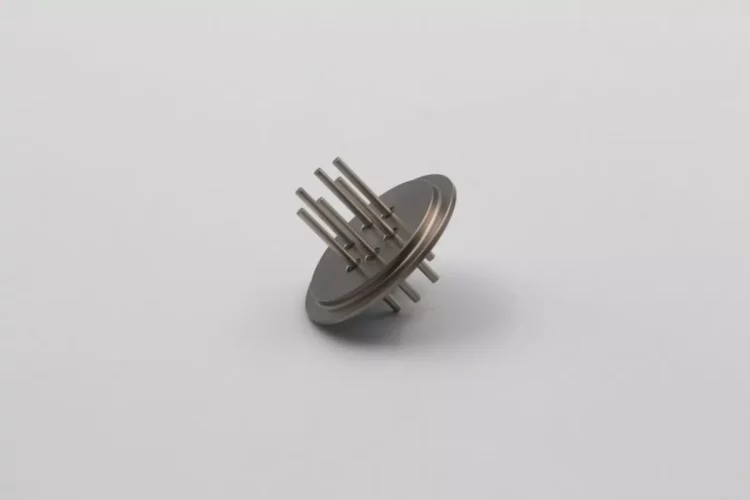
Temperature sensors in industrial furnaces are another case. Thermocouples and RTDs need extension wires that pass through a cold wall. If the seal fails, hot gases escape, or outside air gets in and oxidizes the sensing element. Glass-to-metal headers are standard here because the coefficient of thermal expansion can be matched to the alloy – think Kovar or stainless steel – so the seal stays compressive across the whole operating range. No stress fractures. No gradual loosening.
Then there are gas sensors – like NDIR CO₂ sensors or electrochemical toxic gas detectors. These often have reference chambers that must stay at a fixed oxygen partial pressure. Any leak changes the calibration. Glass-to-metal sealing gives you that true hermetic barrier, not just a “tight” fit. And because the glass is chemically inert, it doesn’t react with the internal atmosphere. That’s critical for long-term drift specs.
Based on my experience, the most overlooked advantage is electrical performance. At high frequencies or high voltages, the glass acts as a stable dielectric. Its capacitance and leakage resistance remain consistent over temperature and time. That matters for piezoelectric sensors and accelerometers, where you’re measuring tiny charge signals. A marginal seal can introduce noise that buries your signal. A good glass-to-metal seal keeps that noise floor low – consistently low.
Let me give you a quick snapshot of typical performance data for sensor-grade glass-to-metal seals. This is what we usually specify in product sheets:
| Parameter | Typical Value |
|---|---|
| Hermeticity (He leak rate) | ≤ 1×10⁻⁹ atm·cc/s |
| Operating temperature range | -200°C to +300°C (some grades up to 450°C) |
| Insulation resistance | > 10¹² Ω at 500 V DC |
| Dielectric strength | ≥ 3 kV AC (depending on pin spacing) |
| Thermal shock resistance | 1,000+ cycles (-55°C to +125°C) |
| Pin material options | Kovar, Alloy 52, stainless steel, copper-core |
| Housing material | Stainless steel, titanium, Monel |
That table isn’t just numbers. It’s proof that when you design a sensor for a twenty-year mission – say, a downhole gauge for geothermal monitoring – you don’t gamble on seals. You pick glass-to-metal. Period.
Now, are there downsides? Sure. The initial tooling cost is higher than potting or rubber grommets. The design has to account for thermal expansion mismatches. And you can’t just change pin count without requalifying the seal. But for high-reliability sensors – the ones that keep people safe, processes efficient, and data honest – those trade-offs are trivial.
So if you’re sourcing sensor components, or you’re specifying a custom housing, don’t treat the feedthrough as an afterthought. That little glass bead around each pin? It’s doing more work than you think. It’s holding back the environment. It’s preserving your accuracy. And it’s doing that year after year, quietly, with no maintenance.
That’s the real value of glass-to-metal sealing in sensors. Not just sealing – but sealing you can bet on.