You don’t always think about ceramics when you picture a nuclear facility. But look inside a reactor, or inside the instrumentation that keeps everything safe, and you’ll find them. Not just any ceramic. 99% alumina ceramic metallization. It’s one of those things that just works—so well that nobody talks about it until something goes wrong.
I’ve spent years around these materials, and here’s what I can tell you: in nuclear environments, the stakes are completely different. You’re not just worried about a part failing. You’re worried about containment. About radiation. About components that have to hold up for decades without being replaced.
So why 99% alumina?
The purity matters. That extra 4% compared to 95% alumina gives you a material that’s dense—really dense. Dense enough that it’s virtually non-porous. In a nuclear setting, porosity is the enemy. If moisture gets in, if contaminants find a path, you lose vacuum integrity. And once you lose that, you’re looking at downtime that costs millions.
But the ceramic alone isn’t enough. You have to seal it to metal—flanges, feedthroughs, housings. That’s where the metallization comes in. The moly-manganese process, followed by nickel plating, creates a transition layer. It’s not a glue, it’s not a mechanical clamp. It’s a high-temperature braze joint that becomes part of the material itself.
In our tests, this joint survives things that would destroy other sealing methods.
Think about a nuclear reactor’s instrumentation feedthrough. It has to carry signals from sensors inside the containment out to the control room. That feedthrough sits in a high-radiation field. It sees temperatures that cycle from ambient to several hundred degrees. And it has to maintain a hermetic seal—no leaks—for the life of the plant.
We’ve pulled these components out after twenty years of service. The ceramic still looks new. The metallization interface shows no signs of oxidation or cracking. That’s the kind of reliability you can’t fake.
Here’s another angle: radiation doesn’t affect 99% alumina the way it affects polymers or even some metals. The crystal structure is stable. Dielectric properties hold steady. So when you need a high-voltage feedthrough inside a containment vessel, or a connector for in-core instrumentation, this material becomes the obvious choice.
It’s also chemically inert. Spent fuel storage, coolant loops, decontamination solutions—none of them attack the ceramic or the metallized interface. You can clean it, expose it to boric acid, let it sit in a radioactive environment, and it just keeps doing its job.
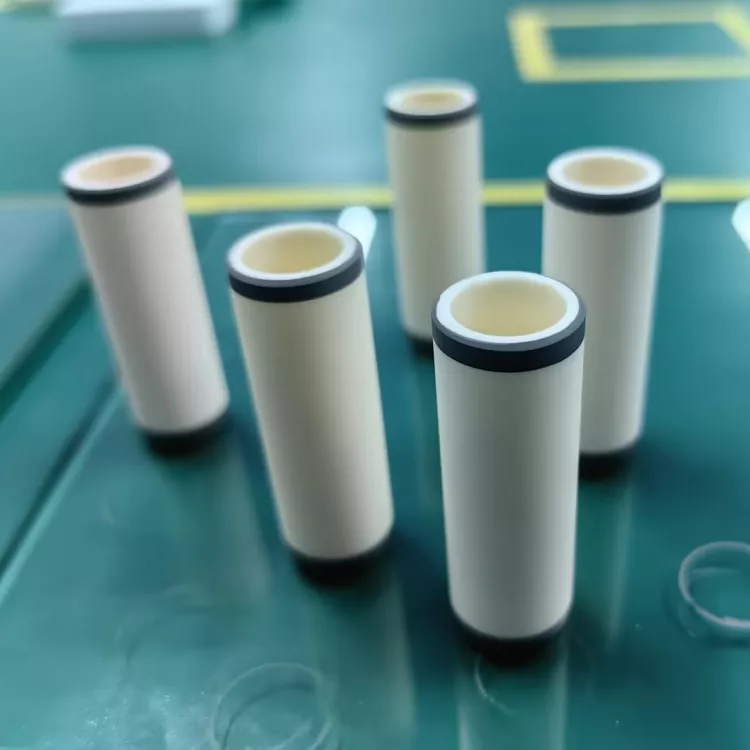
Based on my experience, engineers who spec components for nuclear applications often over-design. They double-check everything. And when they land on 99% alumina ceramic metallization, it’s not because it’s the cheapest option. It’s because they’ve seen the alternatives fail. They’ve seen glass-to-metal seals crack under thermal shock. They’ve seen polymer seals degrade from radiation. But the ceramic metal seal? It stays boring. And in nuclear, boring is beautiful.
So next time you’re looking at a nuclear instrumentation diagram, or you’re specifying a vacuum feedthrough for a research reactor, take a close look at the insulator. If it’s that dense white ceramic with a metalized ring brazed to it, you’ll know why it’s there. It’s not doing anything flashy. It’s just quietly keeping the vacuum tight, the signals clear, and the containment secure—year after year after year.