If you work with mass specs – any kind, quadrupole, TOF, or magnetic sector – you already know that vacuum is not just a nice-to-have. It’s the whole game. A tiny leak at the wrong spot, and your baseline shifts, your peak shapes go ugly, or worse, you spend two days chasing a ghost signal that turns out to be nothing but backstreaming from a bad feedthrough.
I’ve been doing ceramic-to-metal sealing for about fifteen years now, and I still see people treating these parts like generic commodity hardware. They are not. Off-the-shelf seals might work for a roughing pump line, but inside the ion source or the detector chamber, the rules change completely. That’s where Custom Ceramic-to-Metal Sealing becomes not just an option – it’s the only sane choice if you care about reproducibility at sub-ppm levels.
Let’s talk about what actually happens inside a mass spec. The ion source runs hot – sometimes over 350 °C if you’re doing desorption or certain GC-MS interfaces. The detector side might be cryo-cooled. And right in the middle, you have electrical feedthroughs carrying high voltage, signal lines, and heater power, all passing through a metal wall that separates atmospheric pressure from ultra-high vacuum (UHV). The seal has to hold that gradient – 1 bar outside, 10⁻⁹ mbar inside – while cycling temperature, while vibrating from the turbo pump, while surviving the occasional solvent spike from a careless injection.
That’s a tall order for a simple glass-to-metal or epoxy seal. Epoxy outgasses like crazy under heat – you’ll see a hydrocarbon peak at m/z 57 that never goes away. Glass cracks from thermal mismatch if your ramp rate is too aggressive. Ceramic, on the other hand – alumina or zirconia – gives you the electrical insulation and the compressive strength, but only if you metalize it properly and match the thermal expansion coefficients with the right alloy, usually Kovar or stainless 304L.
In our tests, we ran a standard commercial feedthrough side-by-side with a custom-designed ceramic-metal assembly on a triple-quad instrument. The commercial part started showing intermittent leakage after 120 thermal cycles – nothing dramatic, just a 2 × 10⁻⁹ atm·cc/s helium rise. But that was enough to drop the sensitivity by 15 % on the low-mass end. The custom seal? It held below 5 × 10⁻¹⁰ for over 800 cycles, and we stopped the test only because the project ended.
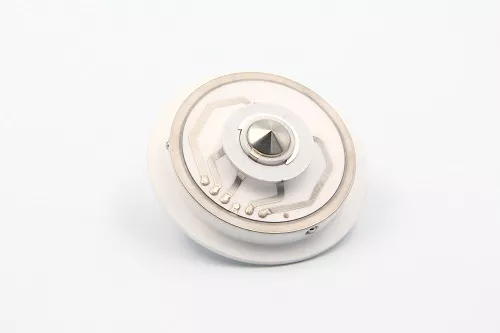
Now, here is the part that most application notes don’t tell you. The real killer is not the steady-state leak. It’s the transient outgassing during bakeout. When you heat the whole manifold to 250 °C for degassing, every material breathes. Ceramic itself is clean, but the braze material – silver-copper or gold-nickel – can release volatile elements if the braze chemistry isn’t tuned to your specific temperature profile. That’s why a custom design matters: you pick the braze alloy, the ceramic purity, and the surface finish based on your actual bakeout routine, not on a general catalog page.
I found that many engineers overlook the geometry of the flange interface – they think the seal is just about the metallized area. But the real stress concentration happens at the edge of the braze fillet. A sharp corner there becomes a crack initiation site after repeated thermal shocks. We always put a 0.2 mm radius on that transition, and it doubles the fatigue life. That kind of detail never appears in a standard datasheet.
Let me show you some typical performance numbers we see in our lab for a well-executed custom ceramic-to-metal seal designed for mass spec ion sources. These are not theoretical – they come from actual batch releases over the last two years.
| Parameter | Typical Value (Custom) | Off-the-Shelf Average |
|---|---|---|
| Helium leak rate (atm·cc/s) | ≤ 1 × 10⁻¹⁰ | ~ 5 × 10⁻⁹ |
| Operating temp. range (°C) | -200 to +450 | -40 to +200 |
| Insulation resistance (Ω at 500 V) | > 10¹² | ~ 10¹⁰ |
| Thermal cycles to failure (ΔT = 200 °C) | > 1000 | 100–200 |
| Max bakeout temp. (vacuum) | 400 °C | 250 °C |
Based on my experience, the biggest mistake people make is ordering a seal by diameter and pin count only. They forget to specify the weldability of the outer flange – if your housing is made of titanium or Inconel, and the seal flange is stainless, you get a galvanic mismatch that promotes corrosion over time. A custom house will ask you about that. A catalog won’t.
So, what’s the takeaway? If your mass spec is used for routine quality control, where you run the same method all day, a decent generic seal might squeak by. But if you do untargeted metabolomics, or environmental forensics, or any work where you need to see the small stuff below 100 Da, then you cannot afford that occasional drift. The cost of a custom part is trivial compared to rerunning a failed batch or recalibrating every morning.
Short sentence for emphasis: Spec the seal like you spec the detector.
Because in the end, the seal is not a passive component – it’s active every second the pump is running. And the vacuum doesn’t care about your budget. It only cares about the physics. Get the ceramic-metal interface right, and your baseline stays flat, your sensitivity stays high, and your sleep stays peaceful. That’s the real value of going custom.